
“AI will soon replace all cybersecurity professionals, rendering them obsolete.”
This kind of alarming headline typifies the gloom-and-doom scenarios often associated with AI’s growing influence in cybersecurity. Yet, upon closer examination, this notion starts to crumble. Indeed, AI is not gearing up to snatch away jobs from humans, notably in cybersecurity, at least not in the near future.
Instead, its transformative role begins to crystalize; not as a usurper but rather as a game-changer. AI is primed to supercharge the capabilities of security teams, redefine their roles, and, paradoxically, highlight the irreplaceability of human oversight.
So let’s shift the narrative from fear to understanding and start a nuanced dialogue about AI’s real impact on cybersecurity. It’s neither fully-autonomous silicon overlords nor completely hands-off operations, but an exciting hybrid with profound implications.
AI’s Prowess in Detecting Cyber Threats
In the dynamic landscape of cybersecurity, AI emerges as an exceptional tool for identifying and managing potential threats. Employing the power of pattern recognition, AI systems can scour and process tremendous volumes of data in a fraction of the time humans would take, rapidly identifying possible dangers.
One critical application area is spotting malware signatures. AI sifts through vast databases at a blistering pace, distinguishing malicious code from benign data and assisting in proactive threat management. As for phishing attempts, predicting such deceptive actions is arduous for humans but notably simplified with AI. Machine learning algorithms process nuance far better, highlighting suspicious email content or unusual URLs that might bypass even the most vigilant cybersecurity professional.
Moreover, in the realm of network security, AI truly shines, observing patterns in a network’s routine operations. A slight deviation, which may slip past human observation, can be a red flag for an AI system, enabling swift action to mitigate any potential risk.
Thus, from proactive threat intelligence to vulnerability management, AI’s capabilities make it an essential ally in our cybersecurity defenses. By leveraging its potent computational power and depth of learning, we’re better equipped than ever to tackle the complex and ever-evolving world of cybersecurity.
AI in Incident Response: Four Crucial Steps
Standing shoulder to shoulder with cybersecurity professionals, AI takes on an integral role during the aftermath of a cyberattack. Even beyond detection capabilities, the technology offers invaluable support in incident response and automation. Let’s observe how in the following four steps:
1. AI leaps into motion upon alert, autonomously categorizing and prioritizing the threat degree. This initial assessment, completed in mere fractions of a second, leaves human analysts precious time to act.
2. The next step is rapid containment. AI’s computational speed can help limit damage, paralyzing the threat in its early stages and preventing its further spread.
3. Like an orchestra conductor, AI manages response playbooks. It deploys prescribed strategies to swiftly neutralize threats, never missing a beat, and thus reducing dwell time—the period between intrusion detection and containment.
4. Lastly, AI processes incident post-mortems. It adopts new tactics, learning from the breach to strengthen defenses for subsequent attacks.
Ultimately, incorporating AI into cybersecurity reduces both the dwell time and the scope for human error, making it a crucial ally in the ongoing battle against cyber threats.
Unmasking the Myth: AI as an Offensive Tool
Often whispered about in hushed tones, the myth circulates: AI, with its ever-growing intelligence, might soon write indestructible malware that no ordinary code can patch. Let’s debunk these tales with solid facts.
Currently, there’s no AI that can architect an unpatchable malware. Human involvement is necessary to exploit vulnerabilities, requiring insights that AI lacks. That’s not to say AI is a benign tool, though. It can indeed aid in cybercrimes when in the wrong hands.
Sophisticated phishing, for instance, often utilizes AI. Cybercriminals harness machine learning to craft extremely convincing fraudulent emails that can dupe unsuspecting victims. Additionally, AI can automate the generation of exploits. It isn’t pretty, but it happens: AI can find and use vulnerabilities, posing new challenges to cyber defense.
Another sneaky move is an adversarial AI attack, which typically involves poisoning training data. Imagine giving a chess AI misleading training data – the best moves become the worst ones, and vice versa. Essentially, it’s diverting AI from its correct learning path with misinformation.
So yes, AI can be used offensively in the world of cybersecurity. But this development isn’t necessarily an omen of doom. Instead, it’s prompting us to improve our defenses – heralding what can be seen as an AI arms race. We’re continually enhancing our security, keeping pace with the advancing realm of AI threats.
Our vigilance doesn’t falter; it sharpens.
As we stride forward, let’s not forget, myths can sound convincing until fact-checked. So let’s continue debunking, learning, and growing stronger in our cyber defense.
Setting the Record Straight: AI’s Rein, Not Rule in Cybersecurity
Addressing AI’s role in cybersecurity, we must balance realism and optimism. Though effective, AI isn’t flawless.
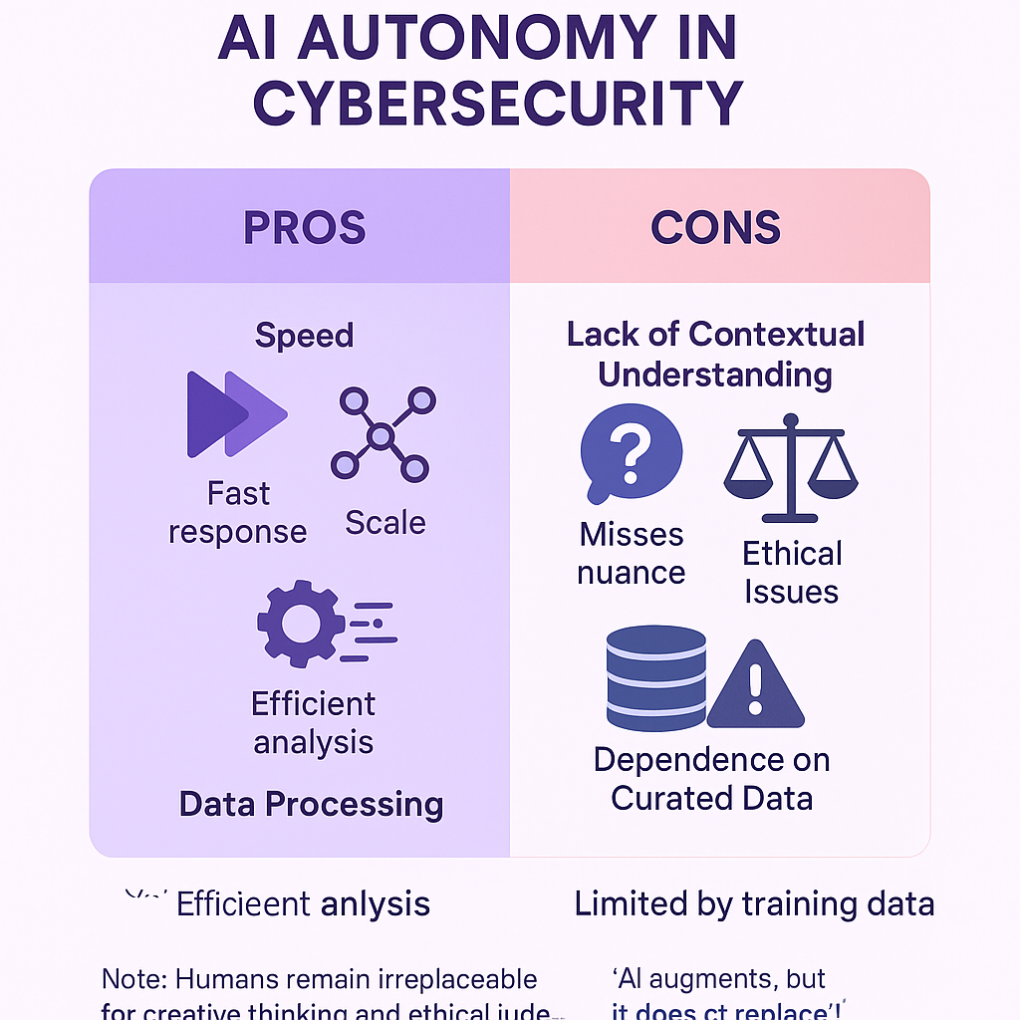
On the pro side, AI’s unparalleled speed and scale offer significant advantages. It processes massive amounts of data almost instantaneously, identifying patterns that may elude human analysts.
Despite AI’s significant capabilities, limitations on its effectiveness become apparent when we consider the intricacies of cybersecurity threats. Nuances like context, creativity, and ethics are essential in evaluating and responding to security threats. These elements are currently beyond AI’s reach.
AI also struggles to comprehend and adapt to entirely novel threats. A sophisticated social engineering attack, for instance, might hoodwink an AI system that’s great at pattern-spotting but falls short in contextual interpretation.
Even in its data processing prowess, AI still leans heavily on curated human data, which could introduce biases and limitations. Plus, AI suffers from explainability issues, often resulting in ‘mystery’ outputs.
AI isn’t poised to replace humans in cybersecurity but rather enhance their capabilities. The human touch in strategic thinking, ethical judgement and intuitive responses remains irreplaceable. Even as AI evolves, we continue to play a critical role, proving our reign in cybersecurity isn’t over – it’s just shared now, with newfound silicon allies.
Pivoting Skills: AI-Augmented Cybersecurity Demands
In the progressively AI-bolstered cybersecurity sector, standing still is falling behind. Traditional ‘hands-on keyboard’ skills morph into ‘strategic oversight and interpretation’ roles.
Here’s a look at critical skills that you’ll need to thrive in the AI-driven cybersecurity reality:
- AI literacy: Comprehending AI’s language is primary; how it learns, adapts, and thinks will bridge the human-AI cooperation.
- Engineering for Security Tools: Prompt engineering aids machine learning security—quicker detection, faster solutions.
- Data Science Basics: Knowledge of data will be your north star, guiding security solution creation and validation.
- Ethical AI Understanding: With AI ethical hacking on the rise, understanding ethical AI implications separates the guard from the governed.
- Strategic Problem-Solving: The battlefield has changed; AI cyber threats demand more strategic thinking and less config tweaking.
- Communication: Articulating AI’s mechanics to non-tech individuals will help stress the importance of AI customer insights to wider teams, aiding in tailoring security solutions.
- Critical Thinking: As risk management AI tools proliferate, your ability to question, analyze and interpret their outputs becomes crucial.
It’s not so much about learning new things but shifting the focus—weighing strategic oversight higher than hands-on action. The future of cybersecurity is a stage set for humans and AI in harmony; preparing for this duet makes all the difference.
Crafting AI Strategy: A Compass for Cybersecurity Teams
Navigating the future of cybersecurity calls for both foresight and deliberate action. It compels organizations to introduce phased AI integration into their security operations like they would nurture flourishing seedlings in a digital garden. This culminates in a blend of timely AI adoption and continuous employee training—a potent cocktail necessary for navigating the AI-driven cybersecurity landscape.
However, the journey doesn’t have to be solitary. Think of AI as an eager apprentice, ready to work alongside established security operations. It’s about harmonizing with the rhythm of existing operations rather than muzzling the orchestra with sudden, discordant notes.
Meanwhile, a robust governance framework should encapsulate AI’s deployment in critical security functions. A skyline of towering ethical rules, legal constraints, and usage limitations will ensure resilient urban planning in the cityscape of AI deployment.
Let’s remember that, despite its colossal potential, our silicon aid is only as good as the hands that guide it.
So, embrace AI, but do it strategically, remembering that a well-executed phased integration and robust governance can fortify your organization against AI cyber threats.
Workforce Evolution: The Softer Side of Cybersecurity Skills
“As a CISO, I can’t stress enough the importance of developing not just the technical, but also the soft skills of our cybersecurity experts. Our field is not just about thwarting AI cyber threats or masterminding machine learning security strategies – not anymore.
We need professionals capable of bridging the knowledge gap between the cyber frontlines and our boardrooms. Professionals who can mediate the dance between AI and our human workforce, ensuring both are valuable players in the cybersecurity ballet.
Consider this—being a cybersecurity wizard means little if one can’t translate that expertise into actionable insights for our whole team. That’s why we’re intent on fostering technical prowess balanced by soft skills in our talent development programs. After all, the landscape of cybersecurity is as much about coding and network analysis as it is about collaboration, communication, and adaptability—essential for the future of our industry.”
- Words of a fictional HR Director, painted with broad strokes yet echoing the reality of the growing importance of ‘technical vs soft skills‘ in cybersecurity.
Harnessing Talent for an AI-Driven Future
Find yourself struggling in the talent gap of the cybersecurity job market? Fret not, a slight recalibration of your hiring strategies might be all you need. Here’s how you catapult your organization into an AI-centric future.
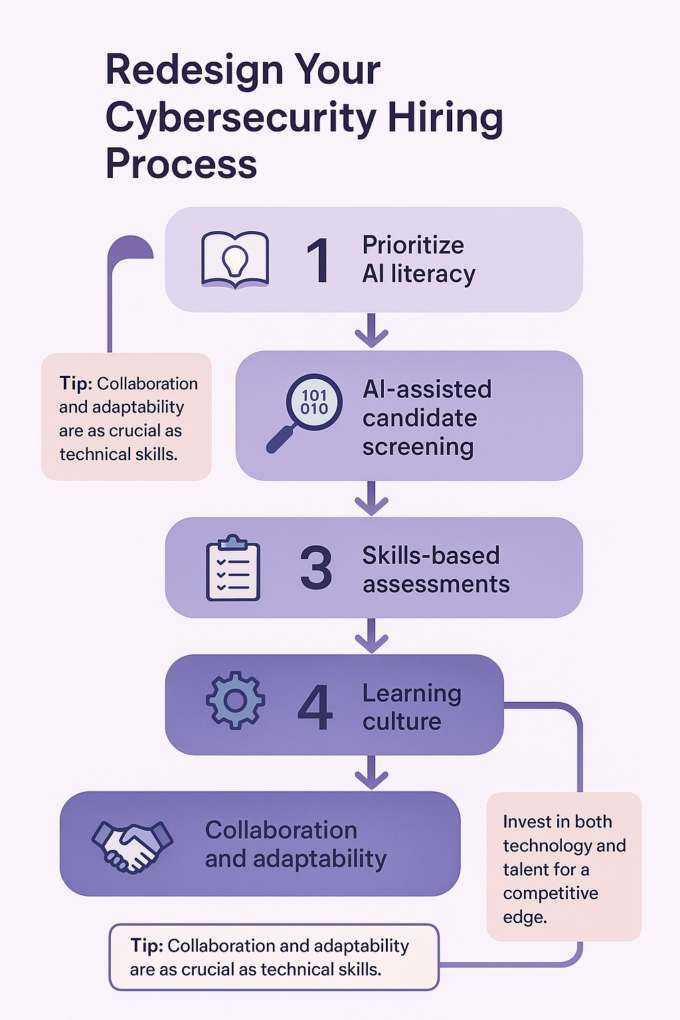
First things first, let AI literacy shine in your job descriptions. By flagging AI prowess as a desired trait, you’d be encouraging a pool of tech-savvy applicants right from the get-go.
Next, hang your hat on skills-based assessments and start sidelining pure credentialism. The cyber landscape is riddled with self-taught whizz kids capable of outpacing certified professionals, so why not tap into that often-underestimated talent pool?
Third, create a culture of continuous learning. Tech advances quicker than a hiccup. Therefore, insisting on an adapt and evolve ethos within your workforce is the key to perpetual relevance.
Fourth, don’t forget to accent cross-functional collaboration. Cybersecurity today isn’t a lone wolf’s game. It requires a combined effort – the IT specialist, the data analyst, the risk manager – all singing in unison.
Last but not least, develop an enlightening ‘hiring process flowchart‘. Integrate AI-assisted screening tools for a more efficient scan through resumes and applications.
Tweak these five points of your hiring process, and you’ll be ready to surf the wave of AI-forward talent flooding the cybersecurity job market.
The Future: Human and AI Teamed Up
Remember, AI’s place in cybersecurity is not an ivory tower but the trenches, side by side with human analysts. The truth is simple, yet pivotal. AI will not replace us in cybersecurity, instead, it will redefine our roles and the nature of cyber threats we face.
Forget the myth of the silicon overlord; the truly thrilling potential lies in their collaboration with our flesh-and-blood analysts. Continuous adaptation remains vital, emphasizing the importance of strategic investment not just in technology but also in human talent.
Buckle up for an exciting journey where AI cyber defense meets human ingenuity. Framed by challenges and opportunities, the future of cybersecurity rests in our hands, symbolizing a dynamic human-driven adventure into the unknown. Enjoy the ride.