
Cloud Security’s Unexpected Challenge
Imagine navigating a labyrinth with constantly shifting walls, hidden pitfalls, and elusive exit points. That’s what monitoring the safety of today’s cloud environment feels like. A beast of escalating complexity, with an ever-expanding attack surface posed by the integration of various networks, devices, and applications. Traditional security models behave like guardians of a fortress, focusing on keeping intruders out of a designated perimeter. But picture this: adversaries that are already inside, lurking amongst your data, waiting to strike. Rendering traditional defenses futile.
Aggravating this predicament is a deluge of data and events that drowns even the most diligent human analysts. The stifling volume of potential threats to sort through makes it almost impossible to detect, leave alone neutralize, genuine threats efficiently. The need for an aid to make sense of this chaos and bolster our defenses is undeniable. Setting the stage for a solution that excels in processing and making sense of vast amounts of information – artificial intelligence.
AI and Cloud Security Unveiled: Mastering the Language
Can you picture AI in cloud security as a highly trained sniffer dog, incessantly hunting for threats at a scale humans can’t match? Instead of sniffing for physical substances, AI-technology sniffs out changes and patterns in your data flows. Are you aware that some patterns could indicate a potential risk, like insider threats or zero-day exploits? Let’s delve deeper into this.
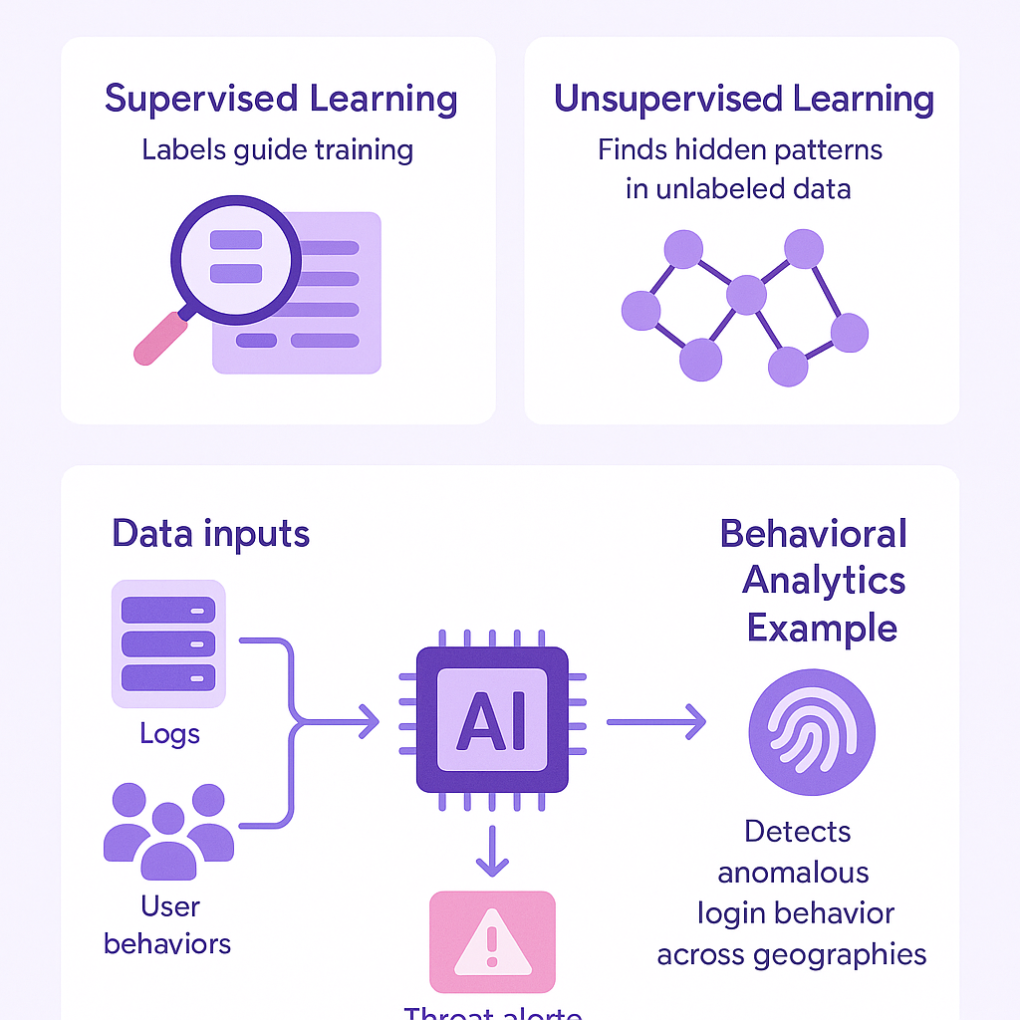
The two core branches of AI employed in cloud security are Machine Learning (ML) and behavioral analytics. On the ML side, you have the dynamic duo of supervised and unsupervised learning. Supervised learning is like teaching a machine with structured lessons, where you expect known responses from the data. Unsupervised learning, however, is more akin to learning through exploration. It is about unearthing surprises in the data that humans might miss. But how does this translate into practical security applications?
Now cut to behavioral analytics and anomaly detection. They add spice to our AI mix by learning normal behavior patterns and alerting when deviant behavior surfaces. Not all anomalies indicate threats, but those deviating far enough from normal patterns could indicate a hidden risk. For instance, ML can spot zealous login attempts on a Sunday night or large data transfers at unusual times, scenarios where static rule sets might falter. We now appreciate that AI in cloud security is not just tech jargon. It signifies the addition of a vigilant, data-combing ally in the immense landscape of cloud security.
AI in Action: Forecasting and Securing the Cloud
Artificial Intelligence is transforming cloud security with four powerful capabilities:
1. Believe it or not, it can forecast future trouble. Known as Predictive Threat Intelligence, AI can anticipate potential malicious attacks by analyzing data patterns. AI doing this is similar to a meteorologist – both predicting storms based on cloud formations.
2. Balanced on the fine line between normal and abnormal, AI’s Automated Anomaly Detection feature shines. It identifies anything deviating from typical cloud network behaviors – quiet as mouse movements or loud as data transfers. The catcher in the cloud rye.
3. With every login attempt, accessing a file, or interacting with an application, AI is there, evaluating the context. Dubbed Adaptive Access Control, AI dynamically adjusts permissions, ensuring authorized actions are safe – a kind of adaptable cloud bouncer.
4. Once a security incident occurs, every second can make a difference. AI speeds up detection and response times, essentially becoming the ambulance of the cloud city. This capability is known as Accelerated Incident Response.
From forecasting to securing, AI has become an essential part of a robust cloud security strategy. These capabilities show us the beautiful marriage of artificial intelligence and cloud security, fostering a safer cloud environment.
Maneuvering the AI Cloud Security Landscape: A Tactical Guide
So you’ve made up your mind: you’re going to wield the power of AI to level up your cloud security game. But where do you start? Consider this your roadmap.
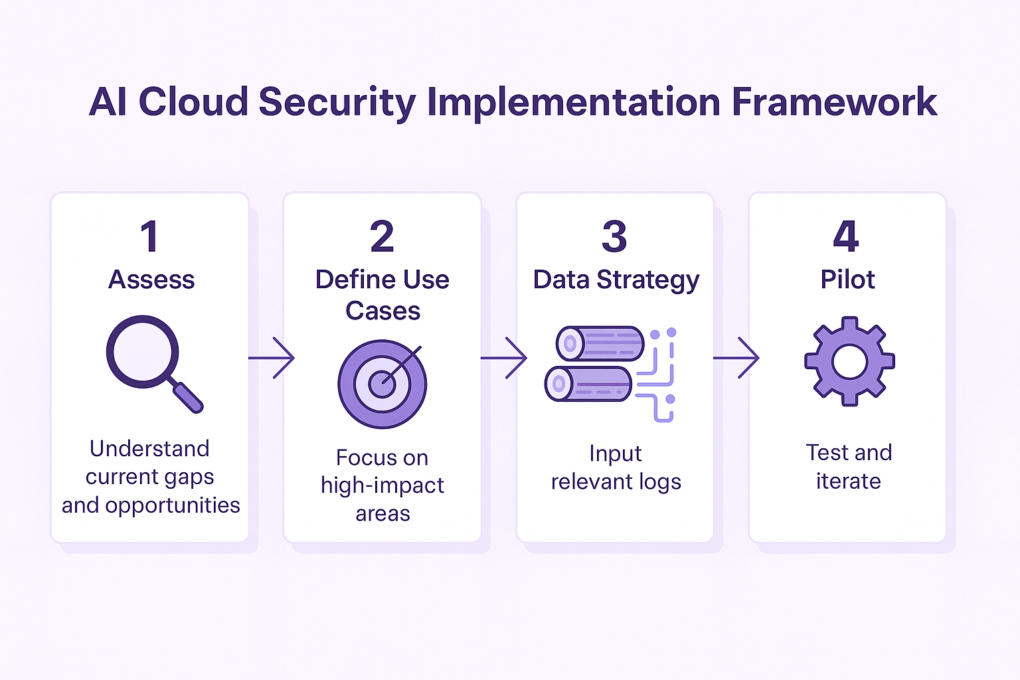
Kick-off with assessment: Your destination is clear – AI-enabled cloud security. However, you must first grasp where you are. Map your current cybersecurity landscape, pinpoint weaknesses and areas where AI can inject maximum power. Evaluate current security protocols, poring over past incidents for recurring patterns. Your goal here is to assess gaps in threat detection, compliance and susceptibility to vulnerabilities.
Enter the realm of use cases: With gaps identified, your target areas become apparent. Frame these areas as specific use cases: automated threat detection, compliance enforcement, or vulnerability management. The possibilities are many. Outline what success looks like for each case to judge how ‘AI-ready’ they are.
Data integration takes center stage: For AI to exhibit its magic, it needs to feed on data, specifically cloud logs, network flows, user behavior, and more. Establishing a robust data pipeline becomes crucial at this stage. This data informs ML algorithms, defining the boundaries of normal behavior and eking out anomalies that might signal threats.
Pilot, measure, fine-tune: Be cautious. Don’t try to win the war in the first battle. Pilot AI on a small scale, keenly observing its impact on security. Rinse, learn, and refine. Crucially, set metrics indicated during the use-case definition to measure performance and gauge success.
Finally, scale and automate: Once confident with AI’s pilot results, think more extensive. Gradually escalate its role, letting AI-managed security become the norm. Simultaneously, focus on automating routine processes, freeing your in-house team for more strategic responsibilities.
Your journey promises to be challenging, but remarkably rewarding. The right AI implementation can bolster your cloud security, heralding a safer, more controlled digital environment.
Specific Applications of AI in Cloud Security
“Better safe than sorry” goes the old saying, and in the realm of cloud security, it couldn’t be truer. But how do I enhance cloud security with AI? A few novel applications exist worth exploring on your journey toward a secure cloud landscape.
Take for instance, Advanced Threat Detection. Cyber threats have morphed over time, from viruses and Trojans to polymorphic malware and fileless attacks. These elusive threats sneak past most traditional security solutions. AI comes to the rescue by identifying these threats through patterns even before they strike, thereby offering a proactive defense.
Then we have Automated Compliance and Governance. The thriving cloud environment demands continuous supervision to maintain compliance with established policies. AI takes the helm here, constantly monitoring systems and alerting you to any configuration drifts, ensuring compliance isn’t an afterthought.
What about protecting valuable information wandering the cloud? Here lies the role of Data Loss Prevention (DLP). By incorporating behavioral context, DLP sifts through data usage patterns to isolate potential leaks and stop data loss before it happens, helping safeguard your precious information.
Lastly, consider Identity & Access Management (IAM) anomaly detection. In an era where user credentials are a prime target, AI aids in elevating security by detecting abnormal IAM patterns, blocking unauthorized access before any significant damage occurs.
Without a doubt, AI’s applications in cloud security can remake your defenses, leaving them resilient and more reactive to evolving threats. These specific applications shed light on AI’s potential in transforming cloud cybersecurity, cultivating an environment that’s significantly safer. Each heralds its impact in minimizing vulnerabilities, unlocking powerful defense mechanisms, and strengthening your organization’s cloud security ecosystem.
Considering the Pros and Cons: AI in Cloud Security
Is adopting AI for cloud security all about cruising in a speedboat under the bright sun? Not exactly. Although painting an exciting future, the inclusion of AI in your cloud security strategy also brings light to some concerns.
On the positive side, AI provides remarkable visibility, allowing you to spot even the slightest anomalies in your network. Furthermore, your response time to any threats dramatically improves, ultimately reducing false positives. It’s like having an ever-watchful sentinel that never sleeps, always ready to counter threats with intelligent, proactive defense mechanisms.
Nevertheless, a few storm clouds hover over this bright landscape. Among them, data privacy emerges as a significant concern, blurring the limits between network security and personal data exploitation. Coupled to this, the notorious ‘black box’ issues create difficulties in explaining how exactly AI makes its decisions.
The initial investment for implementing AI-driven security may also make you pause for a moment. Furthermore, finding skilled specialists knowledgeable in both AI and security is akin to searching for a needle in a haystack, highlighting an unfortunate skill gap in the industry.
Still, with its promise of a more secure cloud environment, the pros of AI security generally overshadow these concerns. One needs to maneuver through the challenges, much like a skilled sailor navigating turbulent waters, harnessing the benefits while mitigating the potential downsides.
Emerging Frontiers: AI and Cloud Security
Artificial Intelligence (AI) is evolving beyond just being a tool in cloud security – it’s becoming an active participant in the ecosystem of serverless security, edge computing, and quantum-resistant cryptography. The convergence of AI with these domains hints at game-changing possibilities in cybersecurity – a radically advanced, more secure future.
Security is embarking on a serverless journey, where running applications without maintaining the servers becomes possible. AI’s potential to guard such systems from threats could play an instrumental role in making serverless security more reliable.
Meanwhile, edge computing, with its ability to process data locally, gets a significant boost as AI ups the ante, swiftly detecting threats at the edge before they can cause harm.
Similarly, in a world bracing for quantum computing’s disruption, quantum-resistant cryptography becomes imperative. AI’s capability to establish new cryptographic standards inversely correlates with any potential vulnerabilities, fortifying the security fabric.
Far from being static, AI is dynamically growing, adapting, and learning. Such evolutionary characteristics allow AI to imbibe nuances of newer threats and fine-tune security responses accordingly. Even more compelling, AI’s evolution is reciprocal given cloud environments’ ever-changing nature – ironically, the constant here is continuous adaptation.
In conclusion, as we ponder the future, it’s clear that AI is a security co-pilot. A silent sentinel in the testing journey that is cloud security, AI offers both flexibility and forward-thinking capabilities that are indeed transforming how we understand and implement security measures.
Essential Points: Leveraging AI for Cloud Security
As we’ve seen, successfully integrating AI into your cloud security strategy offers unique advantages but also calls for careful thought. It’s not about replacing existing solutions, but enhancing them, using AI as a force multiplier to ensure unprecedented visibility and response time.
Starting with well-defined use cases fosters practical application while maintaining a keen emphasis on data quality boosts the accuracy and efficacy of AI models. Several challenges exist, such as data privacy and the opaque ‘black box’ of AI decision-making, that necessitate thoughtful navigation.
Key to your strategy, remember: the success of AI in cloud security resides in continuous learning and adaptation to always stay a step ahead of evolving threats. In our shifting cloud environment, the only constant is change, and AI’s aptitude for continuous adaptation is a substantial asset. Let’s harness it judiciously and make our cloud environments safer.
The Indispensability of AI in Cloud Security
AI is no longer an option, but a strategic imperative in modern cloud security. From forecasting threats to swift responses, AI’s integration is redefining competitive advantage and resilience. Organizations can no longer afford to idle – the time to bring AI into the cloud security fold is now.